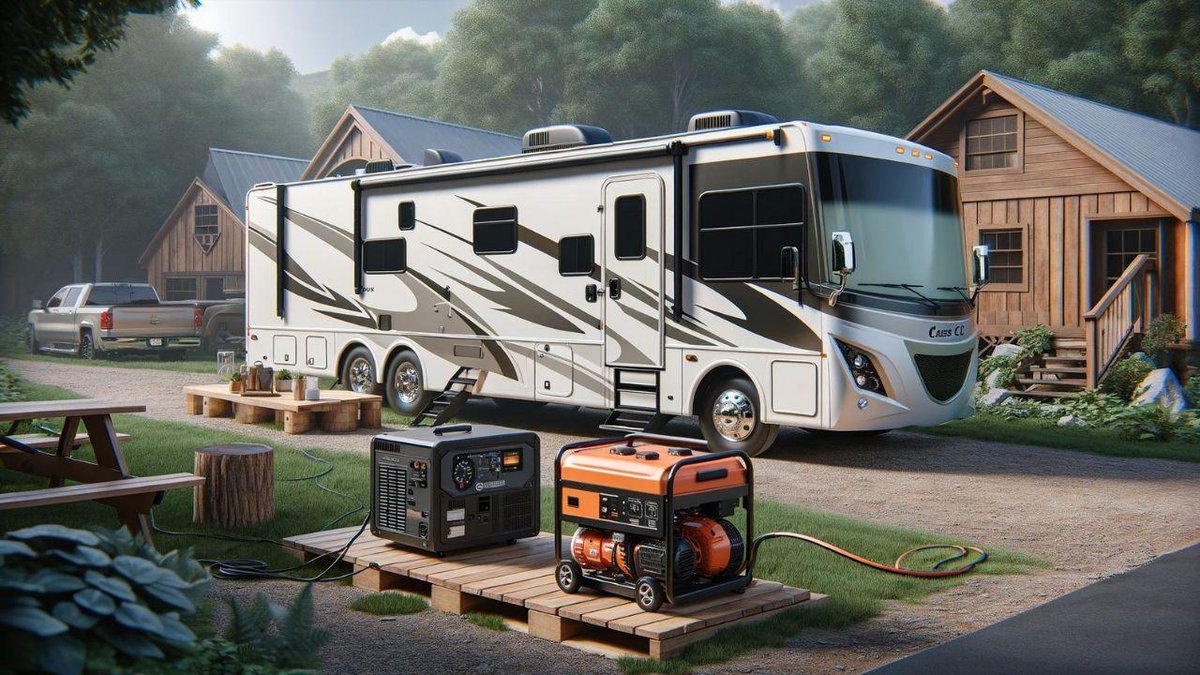
Embarking on an outdoor adventure or hitting the open road in your RV promises freedom and discovery. But even the wildest places demand a touch of modern convenience, and that's where Portable Smart Generators for Outdoor & RV Use become your ultimate travel companion. Forget the days of loud, unreliable power sources; today's generators are quieter, cleaner, and smarter than ever, ensuring your devices stay charged, your coffee brews, and your RV feels like home, no matter how far off the grid you roam.
At a Glance: Why a Portable Smart Generator is Your Next Must-Have Gear
- Whisper-Quiet Operation: Enjoy nature's sounds, not your generator's roar. Many models run below 60 dB.
- Clean, Stable Power: Safely charge sensitive electronics like laptops, smartphones, and even medical devices thanks to low THD (Total Harmonic Distortion).
- Fuel Flexibility: Choose between gasoline, propane, or convenient dual-fuel options for extended runtime and versatility.
- Compact & Lightweight: Easy to transport, store, and set up, often with wheels and telescopic handles.
- RV-Ready: Dedicated TT-30R outlets connect directly to your RV's shore power inlet.
- Enhanced Safety: Built-in CO sensors, low-oil/fuel shutdowns, and overload protection keep you and your gear safe.
- Eco-Friendly Modes: Optimize fuel consumption and reduce noise by automatically adjusting engine speed to demand.
Unlocking Freedom: The Evolution of Portable Power
The call of the wild often comes with a desire for comfort. Whether you're boondocking in a remote campsite, enjoying a tailgate party, or simply need reliable backup power at home, a portable generator bridges the gap. The game-changer? Inverter technology. Unlike traditional generators that run at a constant speed to produce power, inverter generators modulate their engine speed based on demand. This isn't just a technical detail; it translates directly into a host of benefits for you.
You get significantly quieter operation, better fuel efficiency, and most importantly, "clean" power – a stable electrical waveform free from spikes and fluctuations. This clean power is crucial for safeguarding your sensitive electronics, from your laptop and drone batteries to essential medical devices.
Decoding "Smart": What Makes These Generators Stand Out?
When we talk about "smart" generators, we're referring to more than just a marketing buzzword. It's about features that enhance convenience, safety, and efficiency, transforming a simple power source into an intelligent energy hub for your adventures.
- Inverter Technology: At its heart, this is what makes a generator "smart." It converts raw DC power into a stable AC output, similar to what you get from your home wall outlets. This process smooths out the power, drastically reducing Total Harmonic Distortion (THD).
- Eco-Mode/Smart Throttle: These features automatically adjust the engine's RPMs to match the electrical load. Need to charge your phone? The engine idles down. Powering your RV's AC? It ramps up. This means less noise, less fuel consumed, and longer runtime.
- Built-in Safety Sensors: Modern smart generators prioritize your well-being. Carbon Monoxide (CO) Watchdog sensors are now common, automatically shutting down the unit if CO levels become unsafe in a confined space. Low-oil and low-fuel shutdowns protect the engine from damage, ensuring your investment lasts longer.
- Versatile Connectivity: Beyond standard AC outlets, smart generators often include 12V DC ports for battery charging, and USB-A and USB-C ports for direct device charging, eliminating the need for bulky adapters. Many also feature RV-ready TT-30R outlets, a non-negotiable for most RV owners.
- Parallel Capability: Need more power without buying a bigger, heavier unit? Many smart generators can be linked together using a parallel kit, combining their output to handle larger loads like an RV air conditioner.
Finding Your Perfect Power Partner: A Buyer's Guide
Choosing the right portable smart generator means matching its capabilities to your specific needs. Here's what to consider:
Power Output: Running vs. Surge Watts
This is the most critical factor. Generators have two watt ratings:
- Running Watts: The continuous power a generator can supply. Add up the running watts of all the devices you plan to operate simultaneously.
- Surge Watts (Starting Watts): The brief burst of extra power needed to start motor-driven appliances like air conditioners, refrigerators, or power tools. This surge can be 2-3 times the running watts for a few seconds.
Always ensure your generator's running watts can handle your continuous load, and its surge watts can cover the initial kick of your largest appliance. For RV use, an RV AC unit (typically 13,500 BTU or 15,000 BTU) will demand a significant surge. For example, a 15,000 BTU RV AC might need 3,000-3,500 surge watts and then settle into 1,500-2,000 running watts. Many smaller units, like the PowerSmart 2500-Watt (2500 peak/1900 running watts), are great for electronics and lights but won't power an RV air conditioner.
Fuel Flexibility: Gas, Propane, and Dual-Fuel
Your fuel choice impacts convenience, runtime, and even performance.
- Gasoline-Only: The most common and generally offers the highest wattage output for a given engine size. Tank sizes typically range from 1.1 to 1.9 gallons, providing 5 to 10+ hours of runtime at partial load. The ERAYAK 2400W, for instance, offers up to 16 hours at 25% load on its 1.6-gallon tank.
- Propane (LPG): Burns cleaner, stores indefinitely, and is often readily available from RV propane tanks. Propane can sometimes result in slightly lower wattage output compared to gasoline for the same generator, but often offers longer runtimes. For example, the WEN DF360iX gets 14 hours from a 20-lb LPG tank at half load.
- Dual-Fuel: The best of both worlds! These generators can run on either gasoline or propane, giving you maximum flexibility. Many, like the WEN DF360iX or WEN DF480iX, feature tool-free quick-connect propane fittings. This flexibility is invaluable for extended trips where one fuel might be scarce. Fuel shutoff features are also great for extending carburetor life by running the unit dry.
The Sound of Silence: Decibels and You
Nobody wants a generator that spoils the tranquility of nature. Inverter generators are renowned for their quiet operation, typically ranging from 52 dB (like the PowerSmart 2500-Watt at 25% load) to around 76 dB (like the PowerSmart 4400W at 23 feet). To put that in perspective:
- 50-60 dB is similar to a normal conversation or a quiet office.
- 70-80 dB is like a vacuum cleaner or busy street traffic.
Most manufacturers quote noise levels at 25% load in Eco Mode and at a specific distance (e.g., 7 or 23 feet). Always check these details. If you're camping in close quarters, aiming for a unit below 60 dB is ideal.
Clean Power Matters: Understanding THD
Total Harmonic Distortion (THD) is a measure of how "clean" the electricity output is. High THD can be harmful to sensitive electronics, causing them to malfunction or even be damaged.
- For sensitive electronics (laptops, phones, smart TVs, medical devices like CPAP machines): Look for THD below 3%.
- For highly sensitive equipment: Aim for THD below 1-1.2%.
Most modern inverter generators excel here, often providing THD under 3% and even below 1.2% at full load, making them perfectly safe for all your gadgets.
Endurance: Runtime and Tank Size
How long do you need power? Runtime is dictated by tank size and the load you put on the generator.
- Larger tanks generally mean longer runtimes. A 1.5-gallon tank might give you 5-7 hours at 50% load, while a 2-gallon tank could extend to 10-14 hours at 25% load (e.g., Oxseryn EDOG04).
- Eco Mode is your friend. By allowing the engine speed to match the load, it significantly extends runtime and conserves fuel.
- Parallel Operation can also indirectly extend runtime for individual units, as they share the load, allowing each to run at a lower RPM.
Go Anywhere: Portability and Weight
You're looking for a portable generator, so its size and weight are key.
- Lighter units (39-50 lbs): Easy for one person to lift and carry, ideal for car camping or small RVs. The PowerSmart 2500-Watt at 39.7 lbs is a great example.
- Heavier units (60-73 lbs): Often come with built-in wheels and telescopic handles for easier transport, suitable for larger RVs or job sites. The WEN 56477i (72.7 lbs) and WEN DF480iX are designed with this in mind.
- Compact dimensions (under 20 inches in any direction): These fit neatly into RV storage bays or truck beds.
Connectivity: Outlets, USB, and RV-Ready
A generator is only as useful as its outlets. Look for:
- 120V AC Outlets (NEMA 5-20R): Typically 2-4 receptacles for standard household appliances.
- RV-Ready Outlet (TT-30R): Essential for directly plugging your RV's 30-amp shore power cord into the generator.
- 12V DC Port: For charging automotive or marine batteries.
- USB Ports (USB-A, USB-C): For direct charging of phones, tablets, and other portable electronics. The Oxseryn EDOG01 offers both USB-A and USB-C.
- Parallel Ports: Allows you to connect two compatible generators for double the power output.
Safety First: Essential Features
Never compromise on safety. Prioritize these features:
- Carbon Monoxide (CO) Sensor: Absolutely crucial. These sensors detect dangerous CO levels and automatically shut down the generator, preventing potentially fatal accidents.
- Low-Oil/Low-Fuel Shutdown: Protects the engine from damage by turning off the unit when oil or fuel levels are critically low.
- Overload Protection: Prevents damage to the generator and connected devices if you draw too much power.
- Fuel Shutoff: Allows you to run the carburetor dry, which is vital for long-term storage and preventing fuel-related issues.
- Indicator Lights: Clearly show power output, low oil, and overload status.
Top Portable Smart Generator Picks for Your Adventures
Let's dive into some of the standout models, highlighting what makes them excellent choices based on common outdoor and RV needs.
The Versatile Dual-Fuel Workhorse: WEN DF360iX
This generator hits a sweet spot for RV owners and those needing reliable home backup. With 3600 starting watts (gas) and 2900 running watts, it delivers clean power (<1.2% THD) from either gasoline or propane. Its tool-free propane quick connect is a huge convenience, and it runs for an impressive 14 hours on a 20-lb LPG tank at half load. Despite its robust output, it's relatively light at 49 lbs and includes an RV-ready TT-30R outlet, CO Watchdog, and parallel capability. If you need robust, flexible power that's quiet (65 dB) and packed with features, this WEN model is a strong contender.
Compact & Quiet for Light Duty: RINADURS (RAD2800i) and PowerSmart 2500-Watt
For campers, tailgaters, or DIYers who need clean power for sensitive electronics without the bulk, smaller units shine. The RINADURS RAD2800i offers 2800 peak/2500 running watts, clean power (<3% THD), and a super quiet Eco Mode for up to 10 hours on a 1.5-gallon tank. At 50.9 lbs, it's portable and includes a CO sensor and versatile outlets (including QC3.0 Type-C).
Similarly, the PowerSmart 2500-Watt (2500 peak/1900 running watts) is exceptionally quiet at 52 dBA (25% load) and lightweight at 39.7 lbs. It's perfect for charging phones, running lights, or small appliances. While its 1900 running watts won't handle an RV AC, its portability and low noise make it ideal for smaller setups. To explore power smart generator solutions further, you can Explore power smart generator solutions and see how models like these fit into various needs.
RV Powerhouse with Comfort: WEN DF480iX and WEN 56477i
When you need more serious power for your RV, especially to run an air conditioner, these WEN models step up.
The WEN DF480iX delivers 4800 starting watts and 4000 running watts on both gasoline and propane, featuring an electric start for effortless operation. Its dual-fuel 224cc engine, combined with very quiet inverter technology and mobility features (wheels and telescopic handle), makes it an RV dream. It's RV-ready with a TT-30R outlet and comprehensive safety features like WEN Watchdog CO Shutdown.
The WEN 56477i is another excellent choice for RVers, providing 4800 starting/4000 running watts. It boasts an incredibly low THD (0.3–1.2%), making it exceptionally safe for the most sensitive electronics. With wheels and a telescopic handle, it’s portable despite its 72.7 lbs weight, and runs quietly at 62 dB (quarter load). Its 1.9-gallon tank provides up to 7 hours at half load, making it a reliable power source for your extended stays.
Robust Power on the Go: Oxseryn EDOG04 and PowerSmart 4400W Portable Inverter Generator
For those needing significant power that's still portable, these models offer a great balance. The Oxseryn EDOG04 provides 4000 peak/3200 running watts from its 208cc OHV engine, with clean inverter power and an RV outlet. It offers an impressive runtime of up to 14 hours at 25% load on its 2-gallon tank, all at a noise level under 72 dBA. At 56 lbs, it's manageable for transport.
The PowerSmart 4400W Portable Inverter Generator packs a punch with 4400 starting and 3600 running watts. Despite its strong output, it remains relatively compact and weighs 61.29 lbs. Its 223cc engine delivers up to 11 hours of runtime at 25% load from a 1.6-gallon tank. While its 76 dB noise level is higher than some ultra-quiet options, it's still suitable for many outdoor and RV scenarios, especially considering its power output and safety features like a CO sensor.
Ultra-Quiet & Super Lightweight: ERAYAK 2400W and Oxseryn EDOG01
If minimal noise and maximum portability are your top priorities for running smaller loads, these generators deliver. The ERAYAK 2400W Portable Inverter Generator is exceptionally quiet at 52.5 dB (7 meters, 25% load) and very light at 42 lbs. With 2400 peak/1800 running watts and ultra-low THD (<1.2%), it's perfect for sensitive electronics, lights, and essential small devices. It boasts an impressive runtime of up to 16 hours at 25% load from its 1.6-gallon tank.
The Oxseryn EDOG01 is another fantastic choice in this category, offering 2500 peak/1800 running watts. Running at a whisper-quiet <58 dBA and weighing only 39.8 lbs, it's incredibly easy to take anywhere. Its clean power (<3% THD) and versatile ports (including USB and Type-C) make it ideal for charging all your gadgets. It also includes an auto-shutdown CO sensor for peace of mind.
Advanced Considerations & FAQs
Beyond the core buying guide, you might have specific questions that pop up. Here are some common ones:
Can a generator inverter safely supply sensitive medical devices like CPAP machines?
Absolutely, yes. This is one of the primary benefits of an inverter generator. Their "pure sine wave" output (low THD) mimics grid power, making them perfectly safe for sensitive electronics and medical devices like CPAP machines. Always ensure you have sufficient running wattage for the CPAP (plus any humidifiers or other accessories) and use a high-quality surge protector for an extra layer of peace of mind.
How do altitude and temperature affect generator performance?
Both factors can impact efficiency.
- Altitude: Generators lose about 3-4% of their power output for every 1,000 feet of elevation above sea level. This is because the air is thinner, meaning less oxygen for combustion. Some generators offer high-altitude jet kits to compensate, which you might need for sustained use above 3,000-5,000 feet.
- Temperature: Extreme heat can cause engines to overheat, while extreme cold can make starting difficult and reduce fuel efficiency. Using the correct oil viscosity for the ambient temperature range is crucial, as is keeping the generator in a sheltered but well-ventilated area.
What are the best applications for remote generator monitoring and control?
Remote monitoring apps, usually via Wi-Fi or Bluetooth, let you check fuel levels, power output, run time, and even start/stop your generator from a distance. Popular examples include Honda My Generator, Yamaha EF Monitor, Westinghouse iGen Wi-Fi, Champion Control, and Generac Mobile Link. These are incredibly convenient, especially if your generator is running outside your RV at night, allowing you to manage it without stepping out.
Are there tax credits or rebates for purchasing inverter generators?
Federal tax credits specifically for portable inverter generators are rare. However, some states, local utilities, or air quality districts might offer rebates or incentives for purchasing cleaner-burning models (like those that are CARB-compliant), inverter generators, or propane/dual-fuel units, often to encourage reduced emissions. It's always worth checking with your local energy provider or state environmental agency.
What's the correct way to store a portable inverter generator long-term?
Proper storage ensures your generator is ready when you need it and extends its lifespan.
- Fuel: If using gasoline, either drain the fuel completely or use a high-quality fuel stabilizer (and run the engine for a few minutes to circulate it). For dual-fuel, ensure the propane connection is sealed.
- Engine Care: Change the oil, clean or replace the air filter, and remove the spark plug to spray a small amount of engine fogging oil into the cylinder, then reinstall the plug.
- Battery (if applicable): Disconnect the battery if it has an electric start. Store it in a cool, dry place and periodically trickle charge it.
- Cleaning & Covering: Clean the exterior, ensuring no debris is in the vents. Cover the generator to protect it from dust and moisture.
- Location: Store it in a dry, elevated area, away from direct sunlight and heat sources.
- Periodic Checks: Even in storage, it's a good idea to start and run the generator for 15-20 minutes every month or two, especially if fuel was stabilized.
Ready for Your Next Adventure
The evolution of portable smart generators has truly transformed how we power our lives on the go. From the quiet hum of an eco-mode engine saving fuel to the peace of mind offered by clean, stable power for sensitive electronics, these machines are more than just power sources—they're enablers of freedom and comfort. By understanding your wattage needs, fuel preferences, and essential features, you can confidently choose the perfect portable smart generator to keep your outdoor adventures and RV lifestyle powered, comfortable, and truly connected.